Name of space: iFloor Location: Reitaku University, Japan Website:https://www.reitaku-u.ac.jp/global/ifloor/ Contact: Colin Mitchell (SALC Coordinator), mitchell@reitaku-u.ac.jp
The Reitaku University iFloor is an innovative space that fosters autonomous language learning among students from all faculties. Our mission is to offer a comprehensive resource hub that enables independent language and cultural learning in a supportive environment.
At the heart of the iFloor is the iLounge, a dynamic conversation space designed for interactive learning with our global teachers and students. Complementing this is our writing centre, which offers both private and group tutoring to enhance students’ writing skills. The presentation terrace serves as a versatile venue for weekly workshops on various topics led by our teachers, as well as for student-hosted presentations and events. In addition to this, the iFloor includes both open and reservable private study areas, accommodating diverse study preferences and promoting a focused learning atmosphere.
Our primary objective is to guide students towards becoming independent learners. This is achieved by offering a blend of resources, expert support, and an environment conducive to self-directed learning. A cornerstone of the iFloor is our extensive language support services. With student support staff and teachers available throughout the day, we provide assistance and contribute a global perspective to language education.
The iFloor is more than just a facility; it’s a vibrant community that nurtures linguistic proficiency and cultural understanding in our diverse student body.
In addition to our core services, the iFloor at Reitaku University is distinguished by several unique initiatives and future plans:
Our student staff are from various countries. This cultural richness has led to the creation of language-specific study groups and events, such as Korean language gatherings, fostering a truly multicultural learning environment.
A noteworthy annual event hosted by iFloor is the ‘Mapathon’, in collaboration with USC, UCLA, and Reitaku University’s engineering department. This initiative involved students in mapping uncharted parts of the world, showcasing our dedication to global awareness and interdisciplinary education.
ReiTalk, our podcast series, features students engaging in English conversations with faculty, peers, and special guests. This platform not only fosters language proficiency but also bridges academic and real-world discussions.
Ongoing research at the iFloor include examining the effectiveness of our team dynamics, the impact of discussion spaces on language acquisition, and strategies for better preparing students for self-directed learning.
The Transformative Autonomous Language Learning Course (TALL) for first and second-year students is an innovative course designed to guide students in setting personal goals, creating effective study plans, overcoming learning obstacles, and reflecting on their progress, thereby enhancing their journey towards autonomous language learning.
If you would like to have your self-access center showcased please complete this form and mail it to: jasalorg@gmail.com.
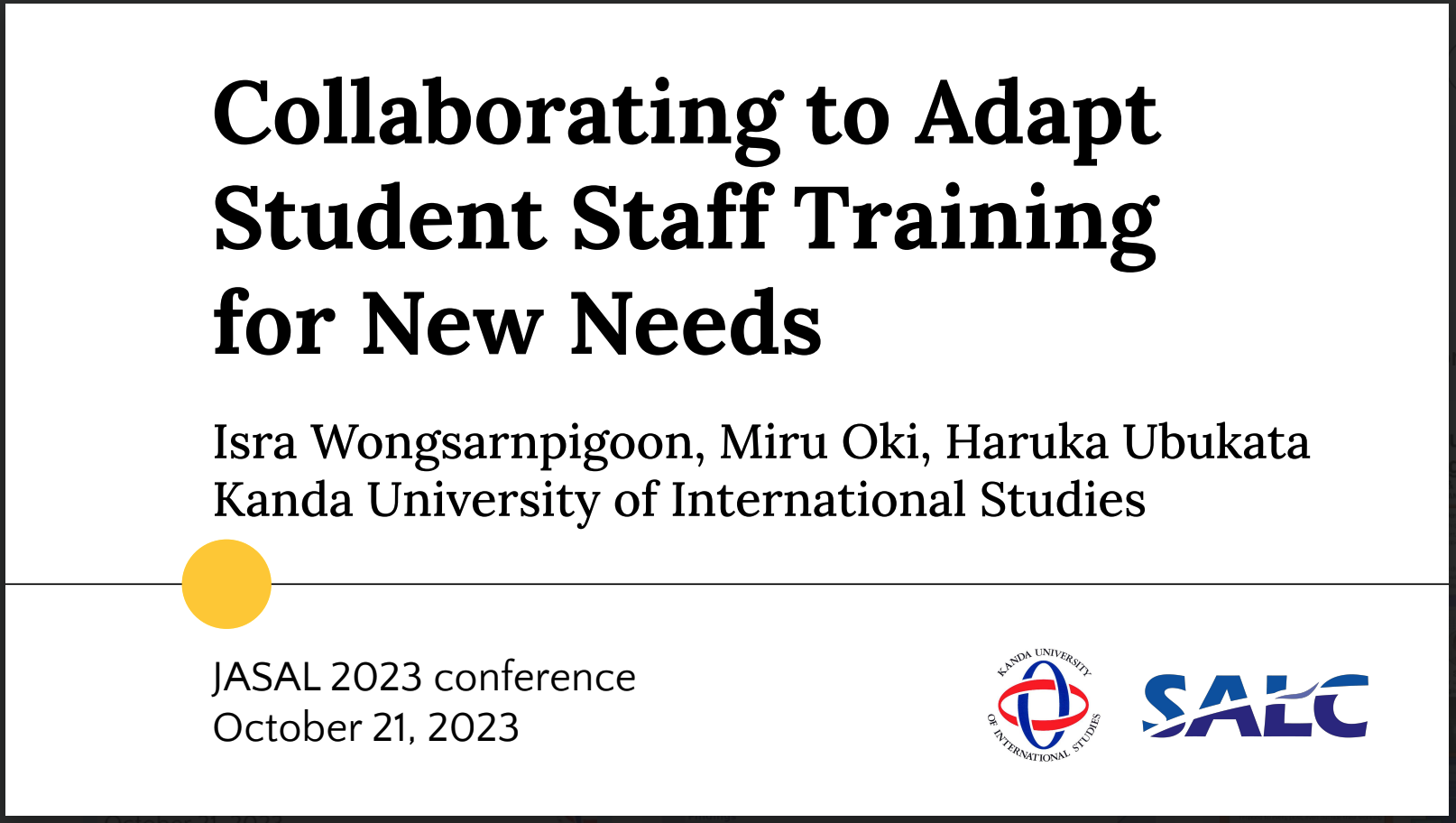
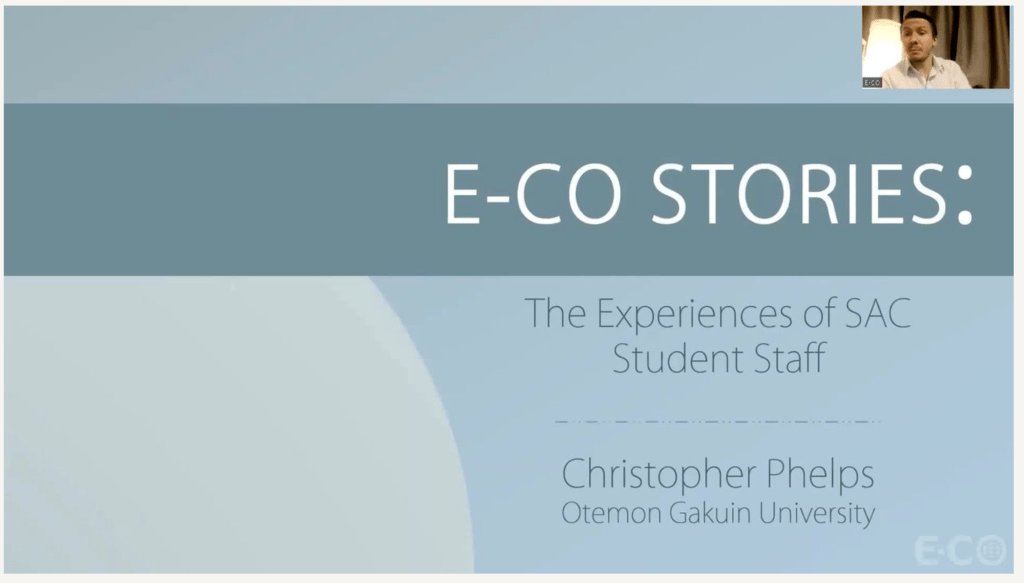
Collaborating to Adapt Student Staff Training for New Needs Isra WONGSARINPIGOON, Miru OKI, & Haruka UBUKATA, Kanda University of International Studies
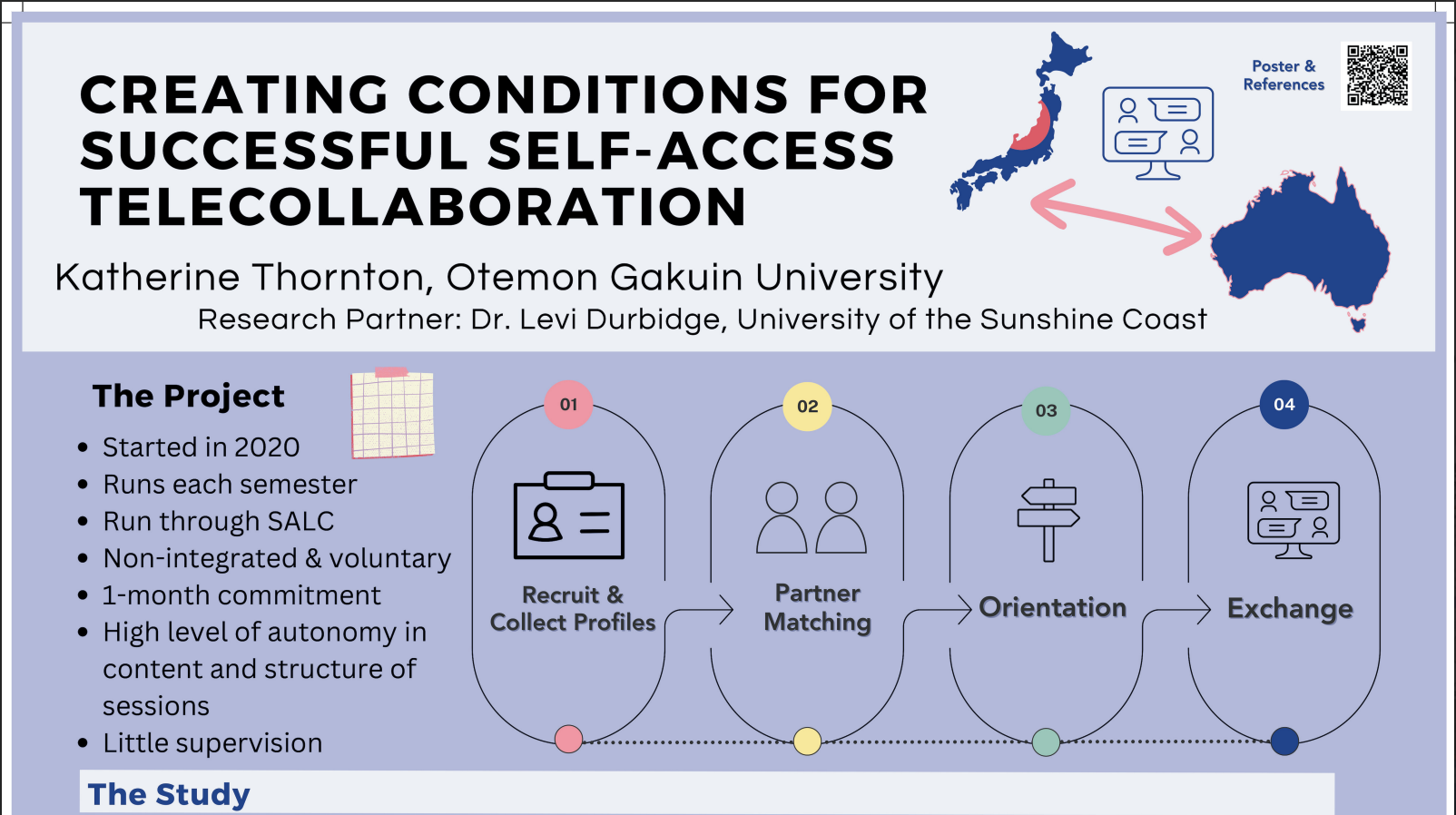
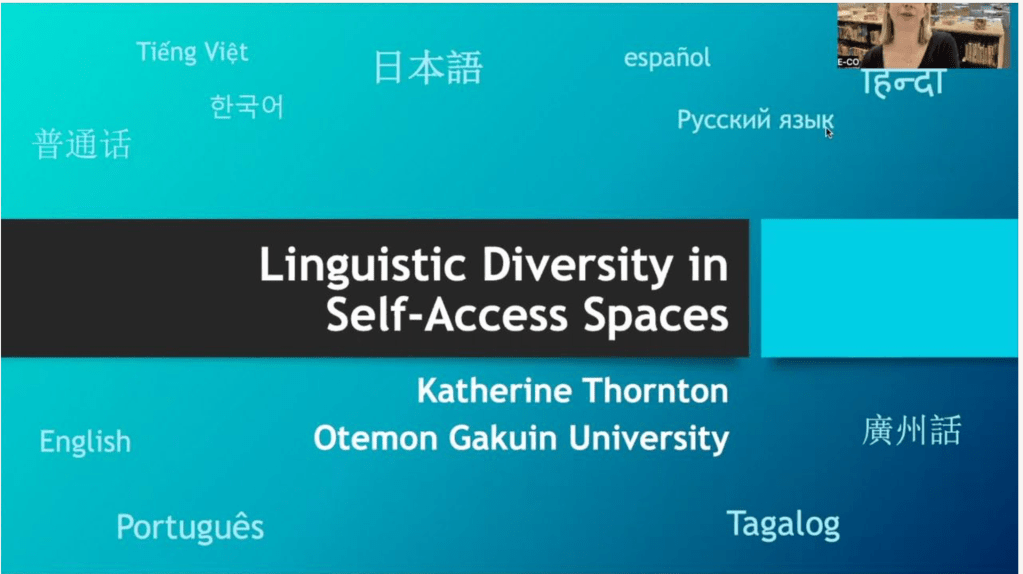
Creating Conditions for Successful Self-Access Telecollaboration Katherine THORTON Otemon Gakuin University & Dr. Levi Durbrige, University of the Sunshine Coast
Thank you to presenters Yaya Yao and Agnes Maria Francis as well as all who joined the JASAL Forum at the JALT conference in Tsukuba, Ibaraki on Saturday, November 25th, from 12:45 – 14:15. Both presentations sparked an introspective dialogue among all in attendance.
Abstracts
Yaya Yao, Kyushyu University
This presentation discusses the potential of translingual arts-based pedagogy in reconceptualizing self-access language learning by sharing preliminary findings of an ongoing study through a university self-access learning center. This approach invites creative, metacognitive exploration drawing on one’s entire linguistic repertoire. As such, translingual arts-based pedagogy has the potential to facilitate a paradigm shift in self-access learning that regards all stakeholders as language learners, challenging native speakerism and building linguistic justice.
AgnesMaria Francis, Konan Women’s University
One key aspect of advising is that every advising session is different. Students who seek advising have various purposes, and unlike teaching classes, there is limited opportunity for prior preparation before each session. Drawing from my experience as an advisor at my previous institution, I noticed that students voluntarily approached advising sessions with clear objectives, and our conversations were centered around specific topics. However, in my current institution, students attend the sessions without a specific purpose in mind although advising is mandatory. As an advisor, it is my responsibility to guide the flow of the advising sessions. In this presentation, I will share the challenges I have encountered, the advising skills that have helped me conduct these sessions effectively, and how this new experience has deepened my understanding of advising.
The 2023 JASAL Student Forum was held online on Saturday, June 10th and it was attended by 13 students and 10 teachers/advisors/members of staff from 9 different universities. We had very interesting discussions about the following questions:
Why did you decide to participate in today’s event? What is your goal today?
How do you study English? What kind of things do you recommend as a SALC staff?
How do you recruit new students to your SALC?
What kind of projects are you working on at the moment in your SALC? Any problems you are dealing with? Any solutions you have found so far?
What did you learn today? What do you want to try in your self-access learning center?
Student participants brought their unique experiences and insights into these pleasant and meaningful discussions. Organizers of the forum were really happy to see the students’ commitment to making their self-access learning centers better. We, organizers of the event, hope that all the participants were able to make some new acquaintances, strengthen their previous connections, gain new insights, and become more motivated to continue the excellent work they are doing in the field of self-access language learning in Japan.
Greetings to all students involved in self-access language learning centers, their advisors, and teachers!
Are you currently working or volunteering for a self-access center at your university?
Are you interested in sharing your self-access-related experiences with students from other universities?
Do you want to meet and hear the stories of other students with similar experiences?
Are your students working on some amazing self-access projects?
Or are they new to self-access and want to hear how other universities are doing?
Then please join us for an online casual discussion over Zoom and share your stories and listen to the stories of others! Teachers, please encourage your students to join the online discussion with students from different universities around Japan. Get some wonderful ideas and make your self-access better and more successful!
Date & Time: 10:00-12:00 Saturday, June 10th, 2023
Format: Online, Zoom meeting
Note: NO NEED to prepare a presentation: just be ready to talk about your center!
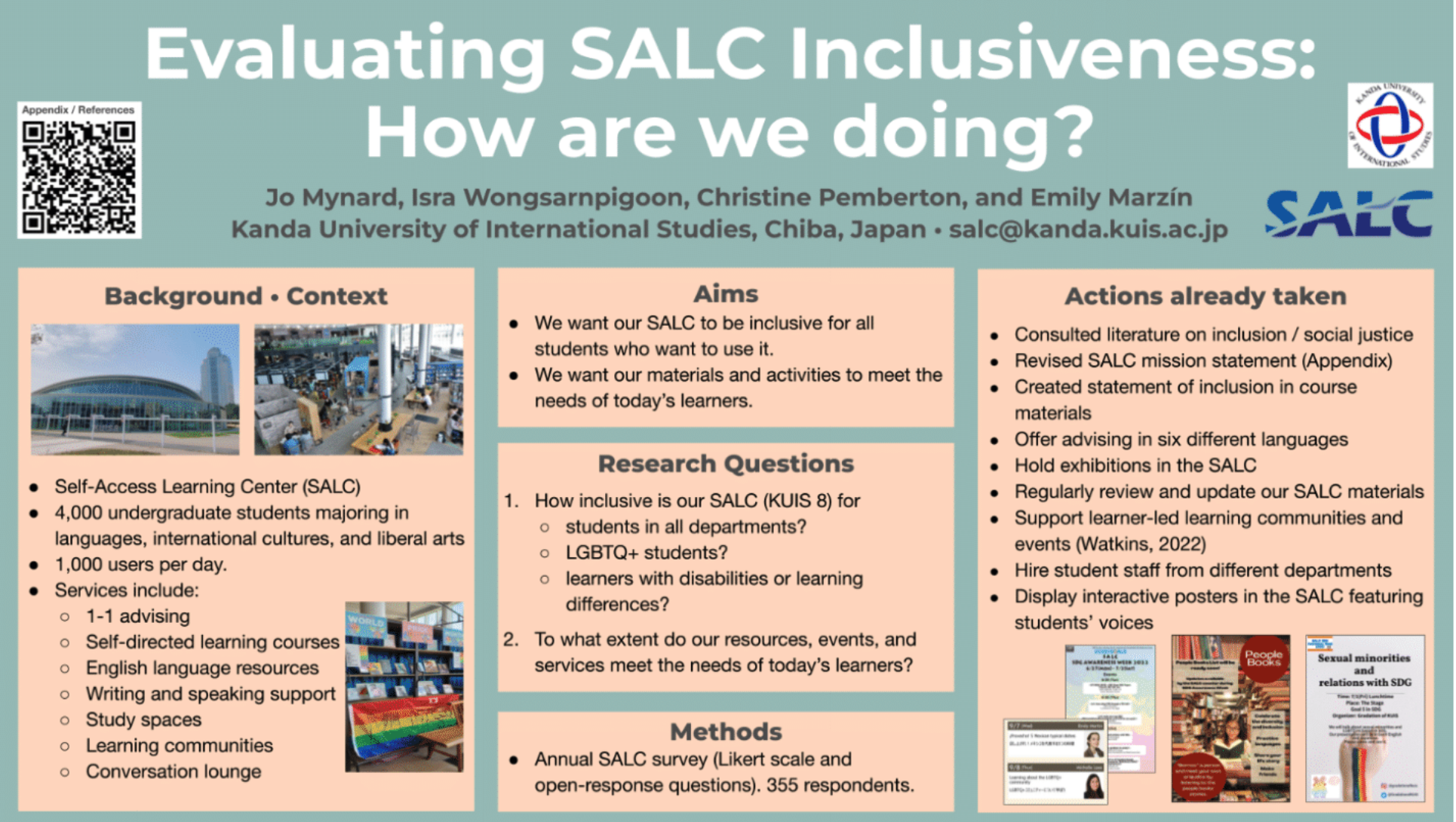
Evaluating SALC Inclusiveness: How Are We Doing? Jo Mynard, Isra Wongsarnpigoon, Christine Pemberton, & Emily Marzin, Kanda University of International Studies









 The Japan Association for Self-Access Learning